Shift-Based Teams: Managing People Who Never Meet
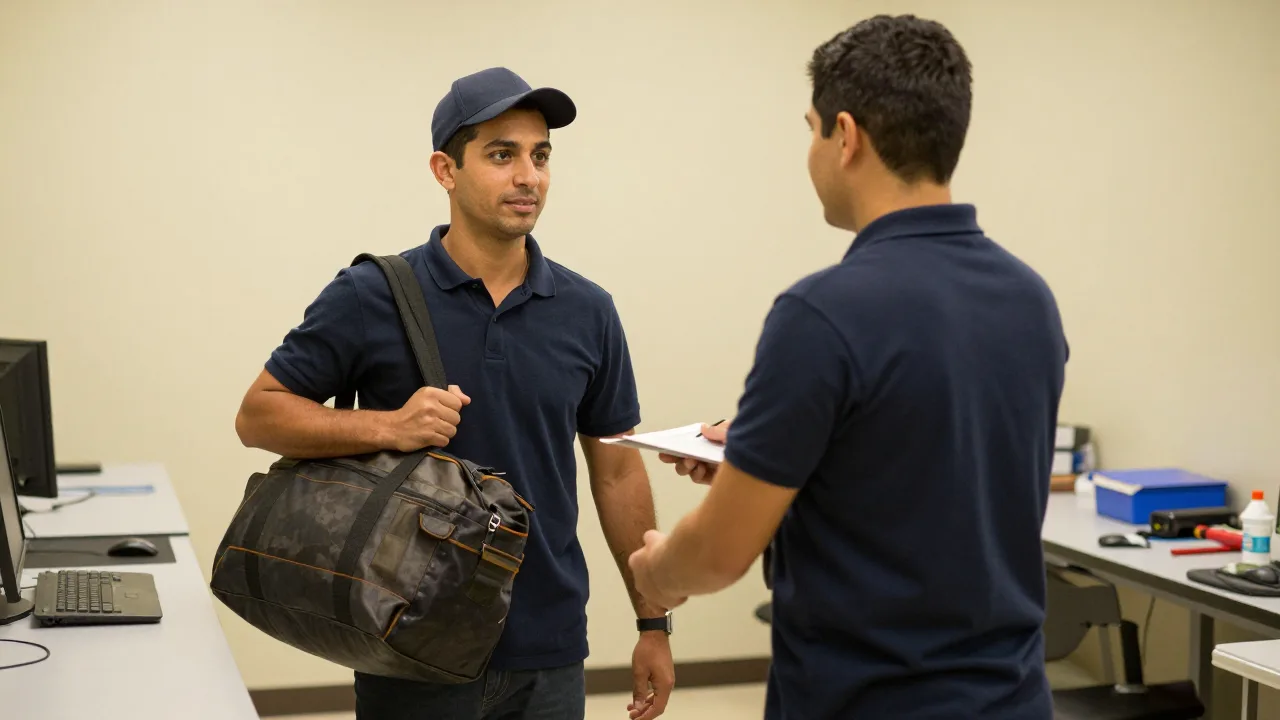
Ask a shift-based operator to name their best employee and their worst, and there's a decent chance both work the shift the manager is on. Not because that shift attracts extremes — because the other shifts are, functionally, invisible.
This is the defining condition of shift-based work: a team on paper, a set of strangers in practice. The 6 AM crew and the 4 PM crew share a building, a payroll, and a customer base, and may go entire quarters without exchanging a sentence. Between them sits a 30-second handoff in a doorway, through which every piece of operational information has to squeeze.
The consequences are predictable and expensive. Information dies at the boundary — the equipment fault reported at 2 PM that nobody knows about at 6 AM. Standards drift apart until two shifts are running measurably different operations. Blame flows across the gap, since it's always easier to assume the other crew left the mess. And off-shift staff quietly conclude they're second-tier, because every announcement, every bit of praise, and every manager conversation happens on somebody else's clock.
None of this is a character flaw in your team. It's what happens when a management model designed for people who share a room gets applied to people who don't. Here's the model that fits.
Fix the Handoff First
If you change one thing, change this. The shift handoff is the single point where information either transfers or is lost, and in most operations it's completely unstructured — a hurried verbal summary from someone who has already mentally clocked out, delivered to someone still putting their bag down.
A structured handover doesn't need to be elaborate. Four fields, five lines, under three minutes to write:
| Field | What Goes In It | Example |
|---|---|---|
| Done | Completed items worth knowing about | "Restocked front cooler, deposit dropped 3:40" |
| Not done | Skipped work and the reason | "Didn't get to back stock — two callouts" |
| Broken / odd | Equipment, systems, anything unusual | "Card reader #2 rebooting itself, ~4 times today" |
| Act now | Anything the next shift must handle immediately | "Vendor calling back before 7 — Marcus knows details" |
Two rules make it stick. First, keep it short enough to be read. A long handover log is an unread handover log, and an unread handover is identical to no handover. Second, if it isn't written, it didn't happen. That sounds harsh but it's protective: it moves the burden off memory and off whoever happened to be standing in the doorway.
Written also beats verbal for a reason people underestimate — it's searchable. Three weeks later, when the card reader finally fails completely, someone can look back and find four prior mentions. Verbal handoffs leave no trail, so recurring problems never accumulate into evidence.
One Channel, and It Counts as the Record
Most shift operations have communication scattered across a group text, a wall whiteboard, a manager's memory, and whatever gets said at the door. The result: nobody knows where to look, so people stop looking.
Pick one channel and make it authoritative. It can be a group chat, a shared board, or a proper mobile scheduling app your staff already carry — the tool matters far less than the exclusivity. Everything operational goes there. Announcements go there rather than being made verbally to whoever's present. Schedule changes go there. The handover goes there.
Then commit to the hardest part: as the manager, stop delivering information verbally to the shift you happen to be on. This is the habit that quietly recreates the two-tier culture, and it's almost entirely unconscious. If you tell the day crew about the new procedure in person and post it for everyone else, the day crew got a conversation and everyone else got a memo — and they can tell.
Short recorded video or voice notes deserve a mention here. Thirty seconds of someone showing the new setup carries tone, context, and visual detail that three paragraphs can't, and takes less time to make than to type. It's the closest thing to being there, and it works especially well for anything spatial. Our roundup of async video communication tools covers the practical options.
Build Overlap on Purpose
Now the part most operators resist, because it costs money: some deliberate paid overlap is worth every dollar.
Fifteen minutes of paid overlap at handoff, for one person on each side, transforms the transition from a doorway shout into an actual conversation. At $17 an hour that's roughly $4.25 per person per transition — call it $2,200 a year for a two-transition-a-day operation. Weigh that against a single equipment failure that went unreported, one no-show that nobody flagged, or the repeated cost of the opening crew spending 20 minutes reconstructing what happened last night.
Beyond the daily handoff, consider periodic all-shift contact:
- A quarterly all-hands, paid, scheduled at a genuinely awkward hour — usually a weekend mid-morning. It's expensive and worth it once a quarter, because it's the only time these people exist in the same room.
- Rotating shift leads. Having a lead work an off-shift once a month spreads standards and breaks the "they always leave it like this" narrative faster than any memo.
- Cross-shift pairing during training. New hires trained across two shifts absorb both cultures and become natural translators between them.
The Two-Company Problem: A 24-Hour Operation With 41 Staff
A round-the-clock facility with 41 employees across three shifts had a persistent quality gap: the overnight shift's output was measurably more variable, and daytime staff had developed the habit of "fixing overnight's work" each morning — roughly 45 minutes of daily rework across two people. Overnight staff, for their part, believed days were exaggerating and that nobody had ever shown them the standard that days were measuring against.
Both were right. Investigation found that four procedural updates over 14 months had been communicated verbally during day-shift huddles and never written down. Overnight had been trained on the original process and had no idea it had changed. The manager, who worked 7 AM to 4 PM, had personally met eleven of the fourteen overnight employees fewer than three times.
Three changes followed: a written handover with the four-field format at every transition, one channel where all operational updates were posted in writing before being said out loud, and a manager schedule that included one overnight shift every two weeks. They also added 15 minutes of paid overlap at each transition, costing about $6,300 a year.
Daily rework dropped to near zero within two months. The manager's own note was the telling one: "I wasn't managing three shifts. I was managing one shift and receiving reports about two others."
Make Fairness Visible
Here's something that surprises managers: most shift-fairness complaints aren't about the actual distribution. They're about opacity. When people can't see the rule, they infer favoritism — and once that inference sets in, no individual schedule can disprove it.
The fix is publishing the rules alongside the schedule. Specifically:
- How desirable and undesirable shifts are distributed. Seniority? Rotation? Volunteer first, then rotate? Any rule beats no stated rule.
- When the schedule posts. A consistent date matters more than a long lead time, though both help. Several states and cities now have predictive scheduling laws with advance-notice requirements and penalty pay for late changes, so check your local rules.
- How swaps get approved. Who approves, how fast, and what disqualifies a swap.
- How time-off requests are prioritized when two people want the same day.
Write these once, post them where the schedule lives, and apply them consistently even when it's inconvenient. The consistency is what's actually being measured. A ready-made starting point is the shift scheduling template generator, which gives you a structure to adapt rather than a blank page.
One System Every Shift Can See
KwickOS keeps schedules, handovers, and team messages in one place your whole staff can reach from a phone — so the overnight crew knows what the morning crew knows.
Explore KwickOS →Recognition Across a Gap
Praise is the most presence-dependent thing a manager does, which makes it the first casualty of shift work. If recognition happens in person, then whoever shares your hours gets recognized, and everyone else gets a quiet lesson about where they rank.
A few practices that close the gap:
- Write it, don't just say it. Post the recognition in the shared channel where all shifts see it. Verbal praise reaches one shift; written praise reaches the team.
- Route customer feedback to the shift that earned it. Positive reviews often name a time of day, not a name. Trace it and credit the right crew.
- Keep an off-shift tally. Literally count, once a month, how many pieces of recognition went to each shift. The imbalance is usually startling and almost always unintentional.
- Never let one shift's fix be framed as another shift's failure. "Nights got the cooler sorted" lands very differently from "nights finally cleaned up days' mess."
Worth naming the subtler version of this too: opportunity is presence-dependent in the same way recognition is. The chance to train on a new station, cover a lead's day off, or sit in on a vendor conversation almost always goes to whoever happens to be there when the opportunity appears. Over a year that compounds into a genuine skills gap between shifts, which then gets read as a talent difference — "days are just stronger" — when it's really an access difference. If you want off-shift staff to develop, you have to route development to them deliberately, the same way you route information.
The same asymmetry applies to problems: an issue raised at 3 AM should get the same response time and seriousness as one raised at 11 AM. Staff track this closely, and a pattern of slower responses off-shift teaches people to stop reporting.
Culture Without Co-Presence
Every article about team culture assumes shared time — the lunch, the huddle, the offhand joke. Shift teams have none of that, and pretending otherwise produces pizza parties that half the staff can't attend.
What does travel across shifts is artifacts: the written record, the standards everyone is held to, the way problems get handled, the tone of the shared channel. Those persist without co-presence, which makes them the actual culture-carriers in a shift operation. The principles overlap substantially with distributed work — a shift gap and a time-zone gap create nearly identical problems — which is why the tactics in our remote team management guide and our piece on building team culture remotely transfer well here even though the settings look nothing alike.
One concrete habit worth stealing from distributed teams: default to writing things down that you'd normally just say. It feels excessive for about two weeks, then it becomes the reason your 3 AM crew knows what your 9 AM crew knows.
Where to Start
Don't attempt all of this at once. In order of return on effort:
- This week: Institute the four-field written handover. Free, immediate, and it will surface problems you didn't know you had.
- This month: Consolidate to one channel and post everything operational there in writing before saying it aloud.
- This quarter: Add 15 minutes of paid overlap at each transition and put yourself on an off-shift rotation.
- This year: Publish the scheduling rules, run one all-shift gathering, and audit where recognition is actually landing.
The underlying shift in thinking is small but load-bearing. Stop managing a team and start managing the boundaries between shifts, because that's where everything is being lost. Your people aren't the problem — the doorway is. And a doorway can be redesigned. Communication habits carry a lot of the weight here, which is why it's worth pairing this with our team communication best practices once the handover is running.