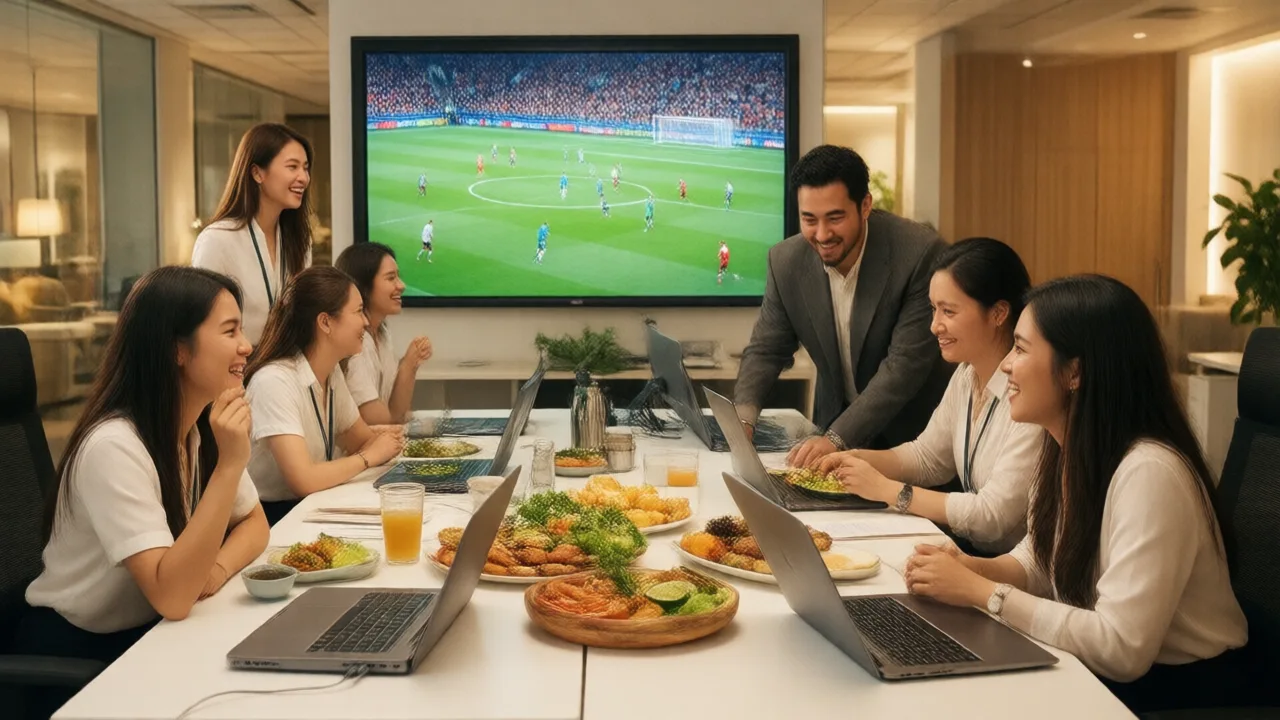
World Cup at Work: A Productivity Plan for Major Sporting Events
A 3pm kickoff on a Wednesday is a productivity event whether management plans for it or not. The teams that handle it well do not pretend nobody cares. They build a coverage plan, protect urgent work, and let people enjoy the match without turning the day into a hidden productivity tax.
The real problem is not the match
Major sporting events expose a management pattern that already exists. If a team depends on surprise availability, undocumented handoffs, and meetings that could have been notes, a high-interest match simply makes the weakness visible. People keep a stream open on a second monitor, mute meetings, answer late, and quietly trade attention for the feeling that they are following the rules.
A better policy starts with a direct assumption: some employees will care a lot, some will not care at all, and the business still has to keep promises to customers. That makes the operational question straightforward. Which work must be covered live, which work can move, and what information has to be written down before attention shifts?
Build a coverage map before match day
The simplest useful tool is a coverage map. It lists the services, customers, locations, or queues that cannot be abandoned, then assigns a primary and backup owner for each block of time. This matters for office teams, remote teams, restaurants, retail locations, support desks, agencies, and any business where one missing person can stall a handoff.
| Work area | Needs live coverage? | Policy |
|---|---|---|
| Customer support inbox | Yes | Assign a rotating primary responder and a backup. Everyone else can watch if the queue stays inside limits. |
| Project planning meeting | No | Move it or replace it with an async update. A meeting with half attention is not alignment. |
| Production release | Usually yes | Avoid risky deploys during predictable distraction windows unless an incident requires it. |
| Front counter or phone line | Yes | Use shift rules and visible handoffs. The customer should not feel the schedule experiment. |
Use async handoffs so people can actually disconnect
A match-hour policy fails when everyone is technically allowed to watch but nobody knows what they are allowed to stop doing. Before the event window, ask each owner to post a short handoff: current status, open risk, blocked work, customer commitments, and the person covering emergencies. That one note prevents the common "I thought you were watching it" failure.
This is the same habit that makes remote work reliable. If your team does not already use written handoffs, start with the patterns in the team communication guide and the knowledge management guide.
Create one quiet channel for urgent work
If employees are allowed to watch together, do not scatter urgent communication across text, Slack, email, calls, and side conversations. Name one quiet channel for true interruption. It can be a support escalation channel, a manager phone, or an on-call thread. The rule should be clear: normal chatter stays out; urgent customer or operational issues go in.
This protects both work and morale. People can enjoy the event because they know where a real interruption will appear. Managers can trust the policy because there is a defined path for urgent work.
Frontline and shift-based teams need a different plan
Office teams can often move a meeting. Frontline teams cannot move the lunch rush, the service counter, or the delivery window. For shift-based teams, the fair policy is usually rotation: one group gets the first half, another gets the second half, and coverage is written into the shift board. Avoid informal "whoever cares most can disappear" rules. They punish the employees who keep working quietly.
For a deeper operating model, use the shift-based team management guide. It covers handoffs for people who never overlap, which is exactly the problem a match-day schedule creates.
Replace low-value meetings, do not move them blindly
A sporting event is a useful excuse to audit meetings. Some should move. Some should become a written update. Some should be cancelled because their only function was habit. If a meeting cannot survive one predictable conflict without damaging the business, it either needs a clearer owner or a clearer purpose.
Use the same decision rule from the meeting overload guide: keep meetings for decisions, conflict, relationship repair, and high-ambiguity work. Convert status sharing, FYI updates, and routine coordination into written notes.
Make the policy explicit and short
Sample policy: "During match windows, non-customer meetings may move or become async. Customer coverage, support queues, and scheduled shifts remain covered by the posted rotation. Urgent issues go in the escalation channel. If your work is covered and your handoff is posted, you may watch without pretending to multitask."
The directness is the point. A vague "be reasonable" policy creates uneven enforcement. A short written policy gives managers and employees the same expectations.
What to review afterward
After the event window, do not ask whether people had fun as the only measure. Ask whether support response stayed within target, whether a handoff failed, whether meetings were successfully replaced with written updates, and whether any employee group carried unfair coverage. That turns a one-day experiment into a better operating habit.
More from AbTeem
For related operating guides, read the hybrid work policy guide, retrospective guide, and SOP guide.